The pharmacist profession in New Zealand
A national research stream on the pharmacist profession: a pharmacist-prescriber descriptive study and a workforce-wellbeing companion study across the wider pharmacy workforce.
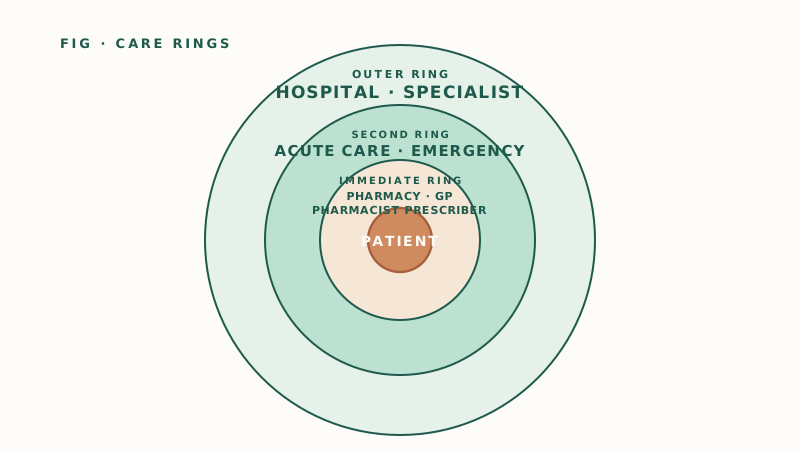
Problem
The pharmacist profession in Aotearoa New Zealand is being asked to do more. Pharmacist prescribing, vaccination services, minor-ailment care, direct-to-pharmacy referrals, and an expanding clinical-pharmacist footprint inside hospital and primary care together describe a workforce whose scope is broader than it has ever been. Policy direction is set toward continuing that expansion. The workforce evolution that has to accompany the policy direction is far less settled. The pharmacist-prescriber programme sits at the leading edge of that change, with a small national pool of active prescribers and most of them practising in primary care, but the more basic profession-wide questions had not been asked at scale. Who is doing what now? Where is the role sustainable, and where is it not?
What I do
I lead a national programme on the pharmacist profession that runs two parallel studies.
The first piece is a descriptive study of pharmacist prescribers in Aotearoa New Zealand. The study combines a cross-sectional survey of active prescribers with semi-structured qualitative interviews of active and past prescribers. I am the principal investigator, and the work is funded by the New Zealand Pharmacy Education and Research Foundation.
The second piece is a workforce-wellbeing companion study using the Maslach Burnout Inventory across the broader pharmacy workforce, not only prescribers. It sits in the same workforce research stream and runs as a separate grant on which I am co-investigator.
The combined picture is what the workforce planners and the regulator actually need. The descriptive arm names what active prescribers are doing and where the role is sustainable. The wellbeing arm provides the workforce context that the descriptive arm cannot resolve on its own.
Evidence
- Cross-sectional survey of 39 active pharmacist prescribers (60.9% response rate from the eligible pool at the time of fielding), reporting on clinical-area mix, full-time-equivalent distribution, salary band, and satisfaction with the role.
- 22 semi-structured qualitative interviews with active and past prescribers, inductive thematic analysis underway as the second manuscript in preparation.
- Principal-investigator paper published in the International Journal of Pharmacy Practice in April 2026, characterising the roles and practice of New Zealand pharmacist prescribers.
- Workforce-wellbeing companion study funded and activated in 2025, running across the broader pharmacy workforce on the Maslach Burnout Inventory.
- Key signals from the descriptive arm: autonomy satisfaction at 91.4%, remuneration dissatisfaction at 54.3%, with 38.7% classified as “overextended” but none meeting full burnout criteria.
Impact
The study is the first comprehensive practice profile of New Zealand pharmacist prescribers, published in an international peer-reviewed pharmacy practice journal. It gives the Pharmacy Council, the school of pharmacy, and the workforce funders a defensible evidence base for workforce decisions over the next decade.
The work is observational by design. It describes the workforce as it is and lets the people who run that workforce make the call on what comes next. The wellbeing-side findings, in particular the gap between high autonomy satisfaction and remuneration dissatisfaction, will inform the next round of advocacy with the funders and the regulator. What a sustainable role looks like as the workforce grows is the question that work will answer.