Metformin in asthma: Cochrane review and emulated trial
A Cochrane review of an old diabetes medicine as a possible treatment for asthma, paired with an emulated-trial analysis to extract causal answers from real-world data.
Problem
Asthma research sits at the intersection of two long-standing problems. The patients who need new options the most also carry the most comorbidity, which makes traditional randomised trials hard to run. And the published literature on metformin (a familiar diabetes medicine that has shown a signal in observational asthma studies) is small, heterogeneous, and almost entirely observational. That kind of evidence does not, on its own, settle whether the apparent benefit is causal or simply correlation through shared lifestyle factors like weight and metabolic control.
What I’m doing
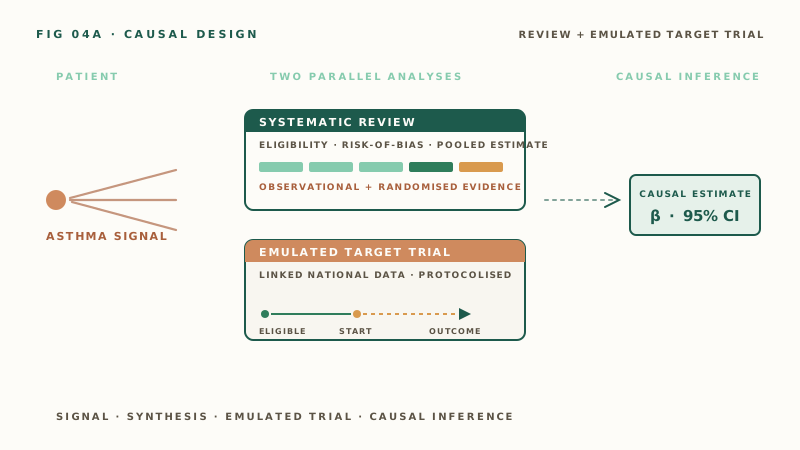
I lead a doctoral programme that runs two analyses on the same question, side by side.
The first is a Cochrane systematic review of metformin in asthma. The review pulls together the published cohort and registry studies, applies the standard risk-of-bias frameworks (one for randomised trials, one for observational designs), and ranks each included study on how well it controls for the major shared causes of metformin use and asthma severity, including body-mass index, smoking, and underlying blood-sugar control.
The second is an emulated-target-trial analysis. It uses linked national health datasets to simulate the randomised trial we cannot ethically run on this question. By specifying the eligibility, the treatment start, the comparator, and the outcome window the way a trialist would write them into a protocol, the emulated trial closes most of the loopholes a naïve observational study leaves open and produces a much more defensible causal estimate.
Evidence
- A Cochrane systematic review of metformin in asthma is in progress. The review draws on the published cohort, registry, and randomised evidence, with each included study scored on how well it controls for the major shared causes of metformin use and asthma severity. Pooled estimates will only be reported once the included studies pass the heterogeneity threshold.
- The emulated-target-trial protocol is registered and runs on the same linked national health data infrastructure as my opioid programme, under the same governance arrangements.
- The work sits inside a doctoral thesis under my supervision. The methods and the structure of the analysis double as a training template for the next set of repurposed-medicine questions in asthma and across other chronic-disease areas.
The work is still in progress. The Cochrane review is not yet published. The emulated trial is an inferential analysis, not a substitute for a definitive trial.
Impact
International asthma guideline panels reach for the Cochrane review first, so the synthesis is the lever that moves practice. The emulated trial, in turn, gives the field a defensible causal answer years before a definitive randomised trial could be funded, run, and analysed.
The combined design is also a template. The same review-plus-emulated-trial pairing is set up to be applied to the next repurposed-medicine question in asthma, and to the doctoral students working with me who are taking the approach into other chronic-disease areas.