AI in research and teaching
AI literacy in clinical academia: opinionated tool choice, AI-inclusive assessments built from the inside, and composable skills with the author still in charge of the argument.
Problem
AI is arriving in research and teaching at the same time, and the institutional response so far has split between two unsatisfying lanes. The first treats AI as a thing to police: assessments rebuilt to detect it, policies written to prohibit it. The second treats AI as a thing to absorb: tools deployed widely with little opinion on which one to reach for, or how to declare what was used. Neither is honest to a clinical-academic discipline. Pharmacy students will use AI in practice. Pharmacy researchers already do. The harder question is what responsible AI literacy looks like for the specific clinical discipline you are teaching, and that question only opens once you stop trying to answer it once for the whole sector.
What I do
The work sits across three lanes.
The first is teaching. I built the first AI-permissive integrated assignment in the School of Pharmacy at the University of Auckland, aligned to the University’s two-lane assessment policy. The assignment is the second-year undergraduate literature-review and critical-appraisal piece on health inequities in indigenous populations. Students are asked to declare which tools they used, what they used them for, and what they verified themselves against the clinical standard of care. What I assess is whether the use is transparent and whether the human still owns the argument.
The second is institutional approval. The tools my Faculty colleagues now use are tools that needed Privacy Impact Assessments before they could touch internal data. I led the assessment work that secured University-wide internal-data-classification approvals for Claude and for Perplexity, drove the active Microsoft Copilot trial across research and analytic agents, and circulated a monthly AI update inside my research team that travelled further than its mailing list.
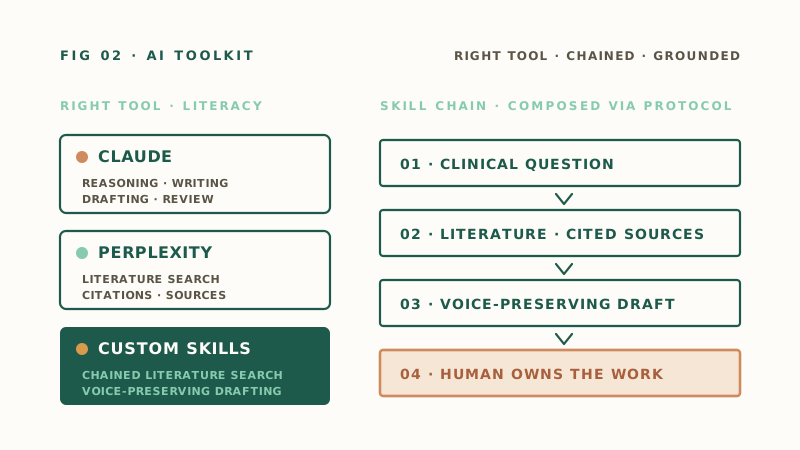
The third is the build. I am a Cogniti learning-agent architect, with working familiarity in retrieval-augmented generation, prompt engineering, and the deployment of learning agents inside Cogniti and other educational and clinical platforms. At the University of Auckland I have deployed three Cogniti agents across two undergraduate pharmacy modules, and we are currently running a study to assess student perceptions of AI deployment in pharmacy education. In research, I run a small set of composable skills that handle literature search and voice-preserving drafting. The literature-search skill chains tool-use protocols across a general web-search service, Perplexity, and the PubMed search interface, so the same query returns broad context, peer-reviewed sources, and verified citations rather than whatever a single chatbot happens to recall. The writing skill is built to do the opposite of what general-purpose chatbots are tuned for. It preserves the author’s voice, names the structural patterns that read as AI-generated, and proposes edits rather than silently rewriting.
Across the three lanes, the through-line is the same. The author owns the argument. The tool is named, the prompt is logged, and the output is verifiable. Copyright sits with the human author. Transparency is what an academic reader is entitled to expect.
Evidence
- AI-permissive integrated assignment in second-year pharmacy, first of its kind in the School, run since 2025 against the University’s two-lane policy.
- Internal-data-classification approvals secured for Claude and for Perplexity, the assessment work originating in the School of Pharmacy and now applying Faculty-wide, with an active Microsoft Copilot trial for research and analytic agents.
- Three Cogniti agents now running across two undergraduate pharmacy modules, with a study currently underway on student perceptions of AI deployment in pharmacy education.
- Learning Leaders Grant (December 2025), funding the continued development of AI tools for pharmacy teaching.
- Faculty Teaching and Learning Committee session on generative AI in pharmacy teaching (2026), and a Faculty doctoral panel invitation on responsible AI use in doctoral research (April 2026).
- Composable research skills in active use across my own programme: a literature-search skill that chains a general web-search service, Perplexity, and the PubMed search interface for grounded sourcing and improved citation accuracy, and a voice-preserving drafting skill.
- Computer Science Honours capstone teams co-supervised on an AI-assisted pharmacy dispensing-accuracy project, run from inside the Faculty of Science as a deliberate cross-disciplinary partnership.
- Good Vibes Only, a Transdisciplinary Ideation Fund project I lead as principal investigator across four faculties. The programme runs a scoping review and a co-design workshop strand to assess AI-assisted application development for health specialists, framed around using AI to reduce the build barrier for clinically-anchored health applications and to deepen the cross-disciplinary collaboration that the work depends on.
Impact
The work is opinionated by design. Students learn which tool to reach for and how to declare its use. Colleagues inherit institutional approvals they did not have to negotiate themselves. Researchers running the toolchain produce drafts faster and keep the academic record honest. Copyright and transparency are treated as clinical-academic responsibilities rather than afterthoughts, because both shape what graduates and researchers will be allowed to do downstream.
This is not a settled programme. The tools change quarterly. The policy frame is still moving. The right answer on copyright and AI in the academic record is being written in public as we go. What I can offer is a working version of opinionated AI use, taught from inside a clinical discipline and held to the same accountability as the rest of the work.